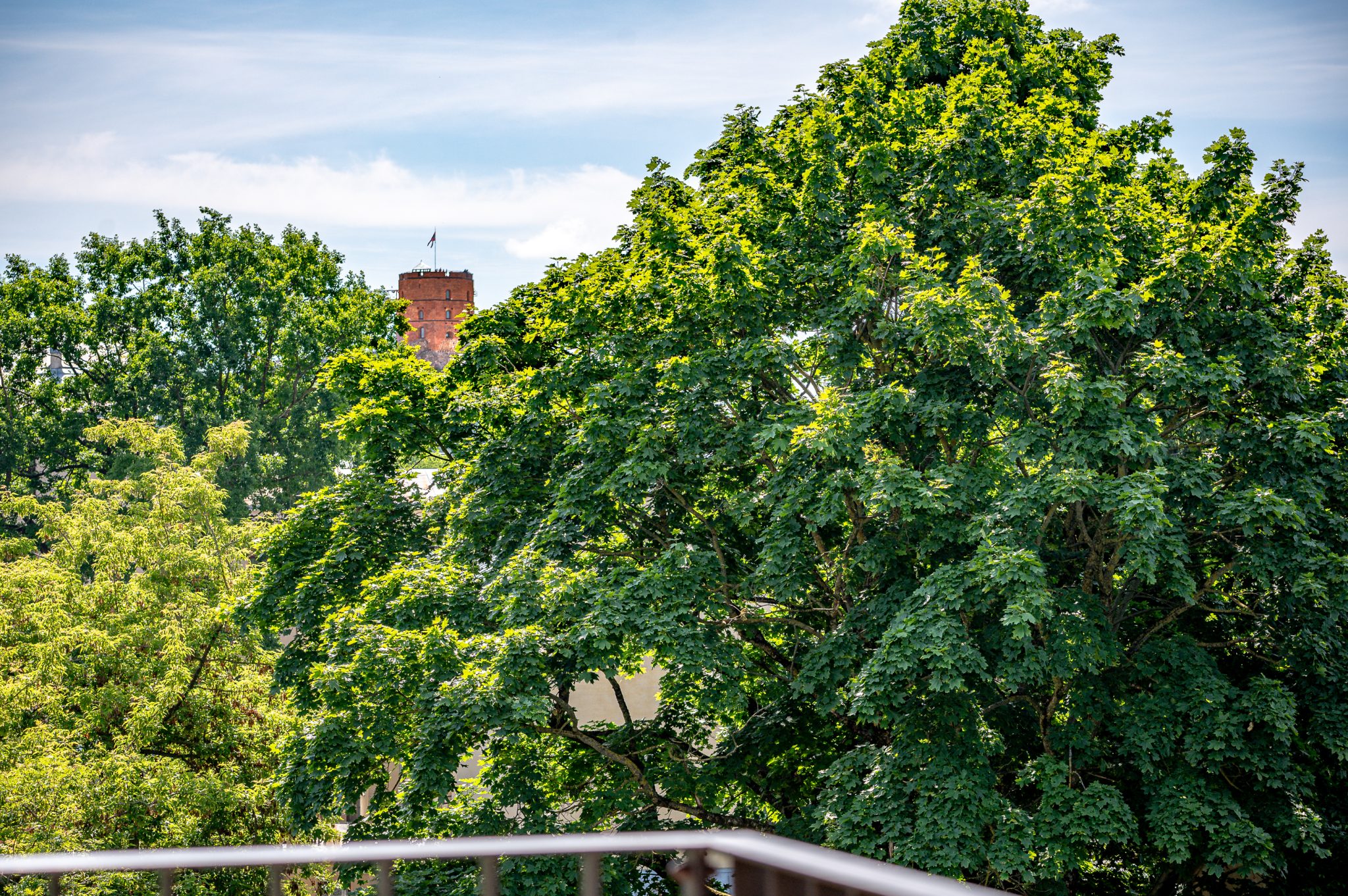
Why Private Green Space Matters in Premium City Living
For a long time, living in the city centre was associated with a compromise: culture, restaurants and workplaces were within walking distance, but residents had to accept a faster pace, less privacy and limited access to greenery.
That model is changing.
In contemporary cities, green space is increasingly viewed not as decoration, but as part of the infrastructure that supports everyday quality of life.
In premium residential property, this matters even more. Value is created not only by the size of the apartment or the view from its windows, but also by the ability to step outside and enter a quiet, green space separated from the street.
At Žygimantų 12, that space is the private inner courtyard.
Why is urban greenery about more than appearance?
Vilnius’ chief city gardener and landscape architect Vaiva Marozienė points out that urban greenery serves far more purposes than simply making a city look attractive.
Vegetation contributes to the urban microclimate, helps reduce heat during summer, supports rainwater management and provides space for biodiversity.
The way cities think about landscape is also changing.
In the past, a well-maintained environment was often associated with closely cut lawns and highly controlled planting. Today, more natural meadows, perennial plants and landscapes that visibly change with the seasons are becoming increasingly valued.
The result is not a static decoration, but a living environment.
The city centre and tranquillity are no longer opposites
One of the clearest changes in premium residential living is the evolving relationship with the city centre.
People want to live close to culture, restaurants, work and urban infrastructure without giving up calm and privacy.
Real estate professional Agnė Klevienė, who has worked with residential projects in Vilnius for more than two decades, identifies two qualities that are becoming increasingly valuable: time and tranquillity.
Modern architectural, acoustic and landscape solutions can create spaces in the heart of the city that feel physically and emotionally separated from its intensity.
The inner courtyard at Žygimantų 12 was designed around this principle.
On one side are central Vilnius, the Neris riverfront and the city’s key destinations within walking distance. On the other is a private courtyard where traffic, movement and city noise give way to greenery and a calmer residential atmosphere.
Why is a private courtyard becoming part of premium living?
Privacy in a premium home does not begin at the apartment door.
The environment outside matters as well.
Does a resident step directly from the building into a busy street? Or is there a space where they can pause, sit outside or spend time with their children?
In large residential developments, courtyards often become heavily used circulation areas for hundreds of residents.
Žygimantų 12 operates on a different scale.
The development consists of only two buildings with 27 apartments each.
The private courtyard is therefore shared by a relatively small residential community.
This allows the landscape to function not as a public city park, but as an extension of home.
Wild strawberries in central Vilnius are more than a design detail
One of the smallest landscape elements at Žygimantų 12 generated one of the strongest responses from future residents.
Wild strawberries were planted in the inner courtyard.
When prospective residents were first invited to meet there, some noticed the berries themselves and immediately began picking them.
No one had pointed them out in advance.
The detail reveals an important principle of landscape design: the strongest emotional response does not necessarily come from the most exotic or expensive plant.
Sometimes familiarity creates more value.
Wild strawberries, rue, anemones, sage and other plants associated with Lithuanian gardens can create a connection with childhood, family homes and familiar landscapes.
Why does premium landscaping not have to be exotic?
High-end landscaping is sometimes associated with rare plants or highly formal compositions.
In the historic centre of Vilnius, however, the stronger solution may be the opposite.
Plants should feel as though they belong.
The relationship with local climate, the traditions of Vilnius and species familiar to local residents therefore becomes important.
This approach also allows the landscape to mature naturally.
A successful courtyard should not look its best only on the day the project opens.
It should become richer as the plants grow.
Privacy in the city is created in layers
Greenery is not only aesthetic.
Planting helps form zones within a courtyard, reduces direct visual exposure between different areas and creates a softer transition between architecture and landscape.
This matters in premium residential design because privacy is more than a locked gate or controlled entrance.
It is created through a sequence of spaces:
the street;
the entrance;
the building;
the private courtyard;
the home.
The clearer the transition between these layers, the greater the sense of separation between the city and the residential environment.
A landscape should change with the seasons
A living garden does not remain the same throughout the year.
Spring brings the first flowers. In summer, planting becomes denser. Autumn changes the colours and textures of the landscape. In winter, the underlying structure becomes more visible.
This seasonal rhythm is one of the most valuable qualities of real nature.
The objective of a good residential landscape is therefore not to create a single perfect “visualisation moment”.
It is to design a place that remains interesting throughout the year.
This becomes particularly important in a home environment that residents experience every day.
One of central Vilnius’ advantages is the proximity between city and nature
Vilnius retains a quality that many European cities are actively trying to recreate: greenery and urban infrastructure remain unusually close to one another in the central part of the city.
At Žygimantų 12, this relationship is particularly clear.
The Neris riverfront is immediately nearby.
Gedimino Avenue, Cathedral Square and the Old Town are all within walking distance.
At the same time, residents have access to a private inner courtyard.
Living here therefore does not require choosing between the city and a calmer residential environment.
A green courtyard is not an amenity. It is part of everyday life
The most valuable residential spaces are rarely those used once a month.
Value comes from the ones that change the daily experience.
Residents see the courtyard when they return home.
They look out onto its greenery.
They walk through it on the way into the city.
They watch it change with the seasons.
For that reason, a well-designed courtyard in a premium residential development is more than another item on a list of amenities.
It becomes part of the home.
Experience the courtyard at Žygimantų 12 in person
Žygimantų 12 is already completed, allowing visitors to experience the relationship between its architecture, landscaping and private courtyard in reality rather than through visualisations.
It is an opportunity to understand not only how the development looks, but how it feels.
We invite you to a private viewing of Žygimantų 12 and its apartments.