Wine Cellars at Home: How to Store and Age Wine Properly
Wine culture in Lithuania has changed considerably over the past few decades. Wine is increasingly becoming part of gastronomy, travel, collecting and everyday cultural life rather than something reserved only for special occasions.
This change also raises a practical question: where and how should wine be stored?
For a few bottles intended to be enjoyed in the near future, a suitable place at home may be enough. A collection designed to age for years or even decades, however, requires much more stable conditions.
Wine expert and founder of Vyno Klubas Arūnas Starkus points to temperature, humidity, light and overall stability as some of the most important factors.
“Once you have tasted a properly aged wine, it becomes clear why certain bottles are worth keeping for a long time. Ageing, however, requires patience and the right environment,” says A. Starkus.
What is the difference between storing and ageing wine?
Not every wine is intended for long-term ageing.
Most wines are made to be enjoyed relatively young. Some, however, have the potential to evolve over many years.
As wine ages, its aromas, texture and overall balance can change significantly.
Time alone is not enough.
If a bottle is stored in excessive heat, exposed to direct light or subjected to frequent temperature changes, the ageing process may accelerate or develop in an undesirable way.
Long-term ageing therefore requires a stable environment.
What is the right temperature for storing wine?
Stable temperature is one of the most important elements of wine storage.
The wine cellars at Žygimantų 12 are designed to maintain a temperature of approximately 10–12°C, allowing wine to develop gradually and consistently.
Avoiding sudden temperature fluctuations is equally important.
Excessive heat is not the only concern. Repeated heating and cooling can also negatively affect how wine develops over time.
For that reason, temperature control is one of the core systems in a professionally designed wine cellar.
Why do humidity and light matter?
Temperature is only one part of proper wine storage.
Humidity also matters, particularly for bottles sealed with natural cork.
Direct and intense light should also be avoided.
This is why professional wine cellars are typically designed as relatively dark and stable environments.
Even lighting is not simply an interior design decision. It should be selected so that it does not negatively affect bottles intended for long-term storage.
Can wine be stored properly in an apartment?
Yes, although the solution depends on how long the wine will be stored and how large the collection is.
For bottles that will be consumed within the next few years, a carefully selected location or a specialised wine cabinet may be sufficient.
Larger collections intended for long-term ageing require more.
Temperature control, sufficient storage space, appropriate shelving and a stable environment all become important.
A detached house may offer the possibility of converting part of a basement into a wine cellar.
In a city apartment, this kind of space is considerably less common.
Why is a wine cellar in a premium residence more than storage?
Collecting wine is rarely only about the bottles themselves.
A collection may hold memories of journeys, individual winemakers, specific vintages or important occasions. Over time, the cellar can therefore become part of the owner’s lifestyle rather than simply a technical storage room.
“A good wine cellar can become a place not only to store bottles, but also to meet and share them. People can taste wine together, exchange stories and discover different regions and vintages,” says A. Starkus.
This idea is reflected in the wine cellars at Žygimantų 12, where private storage is combined with a shared residents’ space.
How are the wine cellars at Žygimantų 12 designed?
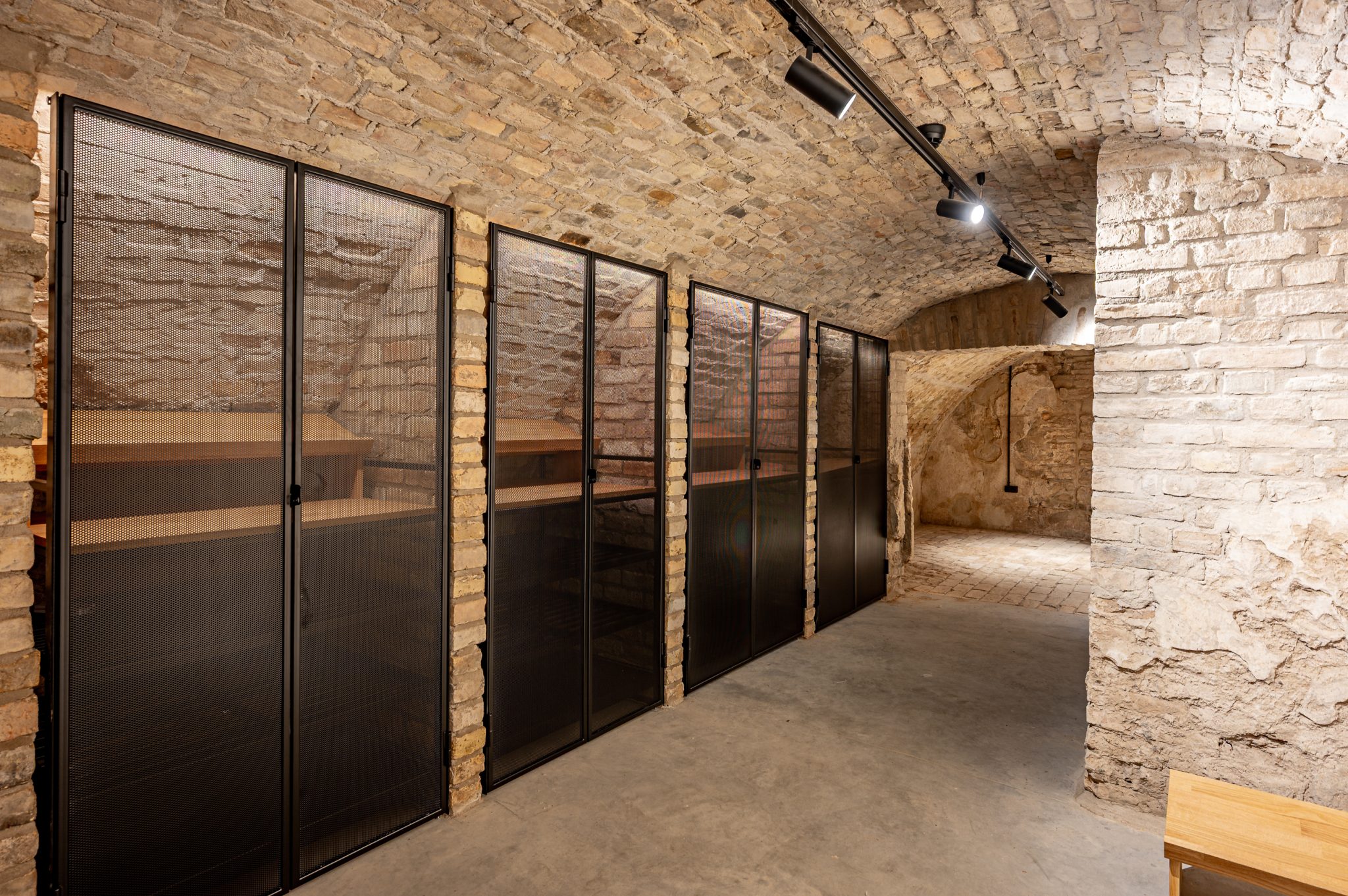
The wine cellars at Žygimantų 12 are located within authentic historic basement spaces of the building.
Together, they cover approximately 70 sq. m.
The cellar is divided into several areas with different functions.
One area is designed as a shared space with 10 private wine cabinets, each able to hold around 50 bottles or more.
Residents will be able not only to store their collections here but also to meet and enjoy wine together.
A completely private wine cellar is also planned for a significantly larger collection.
Historic character combined with contemporary technology
The design of the cellar was developed to preserve the original character of the building while providing the technical conditions required for modern wine storage.
Authentic structural and masonry elements have been retained as part of the restoration.
At the same time, temperature and humidity control systems, specialised lighting and durable storage solutions have been integrated into the space.
“What I saw in the cellar at Žygimantų 12 is unusual for a residential development. Wine is not simply given a dedicated space – the technical requirements of proper storage have been considered professionally as well,” says A. Starkus.
This combination of historic architecture and contemporary technology allows the cellar to serve a real purpose rather than exist merely as a decorative feature.
A wine cellar as part of a lifestyle
The value of a premium home increasingly extends beyond the apartment itself.
Shared and private amenities can remove everyday inconveniences and provide functions that would otherwise need to be found elsewhere.
For one resident, that may mean convenient underground parking. For another, it may be a concierge, private courtyard or additional storage.
For a wine collector, it may be a professionally designed cellar.
At Žygimantų 12, this function is also connected to the history of the building.
The historic cellar spaces are preserved not as museum exhibits but adapted for contemporary use.
What should you consider when choosing a place for a wine collection?
If wine is intended for long-term storage, at least five factors are worth considering:
- whether the temperature remains stable;
- whether humidity is controlled;
- whether the wine is protected from direct light;
- whether the storage environment is free from constant vibration and major fluctuations;
- whether the collection can be organised and accessed conveniently.
The right environment allows wine to develop gradually and as intended by its producer.
A well-designed cellar can also become one of the most personal spaces in a home.
Wine cellars at Žygimantų 12
Žygimantų 12 is already completed, allowing prospective residents to experience the apartments and shared spaces in person.
We invite you to discover not only a home in central Vilnius, but also the distinctive private and shared spaces that form part of the Žygimantų 12 experience.